
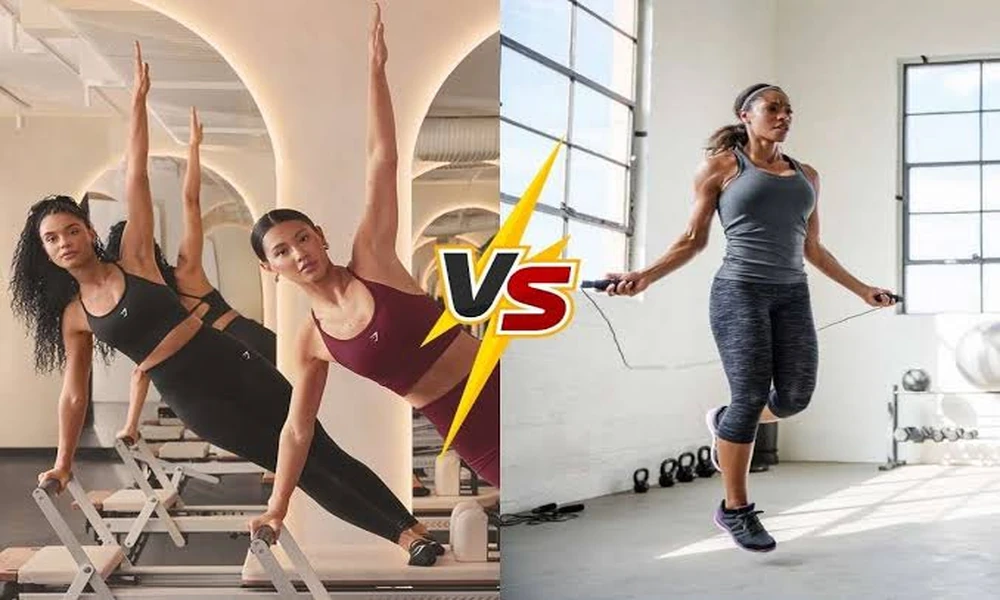
Ask five people how to build a stronger core and you’ll likely get five different answers. Two that come up constantly these days are Pilates and EMS training, and they couldn’t be more different in how they work, even though both are marketed as fast, effective ways to strengthen your midsection. If you’re trying to decide where to put your time, it helps to understand what’s actually happening in your body during each one, rather than just going by which studio has the better Instagram feed.
How Pilates Builds Core Strength
Pilates works through controlled, deliberate movement. Every exercise is built around engaging deep stabilizing muscles, particularly the transverse abdominis and pelvic floor, while maintaining precise alignment and breath control. It’s slow by design, and that’s the point. Rather than fatiguing muscles through repetition alone, Pilates trains your body to recruit the right muscles in the right sequence, which is why people often notice improved posture and better movement control before they notice visible changes in strength.
The core benefits of Pilates in Chandigarh studios tend to show up gradually, over several weeks of consistent practice, but they tend to be durable because the strength is built through genuine neuromuscular control rather than brute repetition.
How EMS Training Builds Core Strength
Electrical Muscle Stimulation works on a completely different principle. During a session, electrical impulses are delivered directly to muscle fibers through a specialized suit, triggering contractions far more intensely and frequently than voluntary movement alone could achieve. A 20-minute EMS session can activate significantly more muscle fibers than an equivalent amount of conventional exercise, which is why it’s often marketed as a time-efficient way to build strength.
EMS training in Chandigarh sessions typically combine light movement with the electrical stimulation, so you’re not just lying still while the suit does the work. The intensity is also adjustable, making it accessible for people who may not tolerate high-impact training well.
So, Which Builds Core Strength Faster?
This depends on what “faster” actually means to you. EMS tends to produce noticeable muscle activation and soreness after just a session or two, since it recruits muscle fibers more intensely than voluntary contraction. For people short on time, this can feel like quicker progress. Pilates, on the other hand, builds strength more gradually but tends to improve functional core stability, the kind that supports posture, balance, and everyday movement, more comprehensively over time.
In practice, EMS is often better suited to accelerating raw muscle activation, while Pilates is better suited to teaching your body how to actually use that strength. Neither is strictly “better,” they’re solving slightly different problems.
A Quick Comparison
- Speed of visible activation: EMS shows faster muscle engagement per session; Pilates builds more gradually.
- Type of strength: EMS emphasizes raw muscle contraction; Pilates emphasizes control, stability, and alignment.
- Time investment: EMS sessions are typically shorter (around 20 minutes); Pilates sessions run longer but improve movement quality alongside strength.
- Best for: EMS suits time-constrained schedules and targeted muscle activation; Pilates suits those wanting long-term postural and functional improvement.
Can You Combine Both?
Many people find combining the two works better than choosing one exclusively. EMS can accelerate muscle activation and recovery, while Pilates reinforces the control and stability needed to actually use that strength functionally in daily movement and other training. This layered approach is part of why some structured fitness programs now build both into the same plan rather than treating them as competing options. A well-designed wellness clinic in Chandigarh will usually assess your starting point and goals before recommending one, the other, or a combination of both, rather than defaulting to whichever is trending that month.
Which Should You Choose?
If your priority is efficient muscle activation within a tight schedule, EMS is worth trying. If you’re after long-term postural correction, injury prevention, or functional strength that carries into daily life, Pilates is likely the better long-term investment. For most people, the honest answer is that a combination, guided by someone who actually assesses your body first, tends to outperform either method used in isolation.
FAQs
Is EMS training safe for beginners?
Generally yes, since intensity is adjustable and sessions are supervised, but people with certain medical conditions such as pacemakers or pregnancy should avoid EMS and consult a doctor first.
How often should I do Pilates to see results?
Most people notice improvements in posture and core control within four to six weeks of practicing two to three times per week, though this varies by individual starting point.
Can EMS replace regular workouts?
EMS is generally best used as a complement to regular movement and exercise rather than a full replacement, since it targets muscle activation but doesn’t replicate cardiovascular or functional movement training.
Does Pilates help with back pain?
Many people find Pilates helpful for mild, non-specific back pain since it strengthens core stabilizers and improves posture, though persistent or severe back pain should be evaluated by a specialist first.
Which is better for weight loss, Pilates or EMS?
Neither is primarily a weight-loss tool on its own. Both build strength and can support a broader fitness routine, but sustainable weight loss typically depends more on overall activity level and nutrition.